Body Scar Revision Surgery
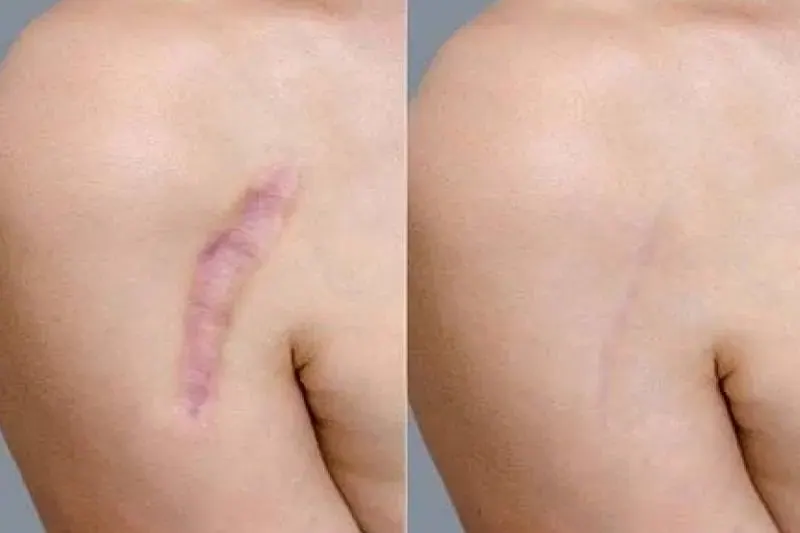
Body scars from previous surgery, accidents, burns, deep cuts, caesarean section, or pregnancy stretch marks can be a permanent source of self-consciousness and, in some cases, restricted movement. Unlike normal scars that fade over time into thin, pale lines, problem scars may become raised, red, thickened, widened, depressed, or pigmented. Two of the most common problem-scar patterns on the body are hypertrophic scars — raised, red scars that stay within the original wound margin — and keloid scars, which grow beyond the original injury and tend to recur if not treated correctly.
Overview
Body scars from previous surgery, accidents, burns, deep cuts, caesarean section, or pregnancy stretch marks can be a permanent source of self-consciousness and, in some cases, restricted movement. Unlike normal scars that fade over time into thin, pale lines, problem scars may become raised, red, thickened, widened, depressed, or pigmented. Two of the most common problem-scar patterns on the body are hypertrophic scars — raised, red scars that stay within the original wound margin — and keloid scars, which grow beyond the original injury and tend to recur if not treated correctly.
Body scar revision is a tailored plan rather than a single procedure, because the optimal approach depends on the size, depth, age, location, and behaviour of each scar. Treatment options range from non-surgical interventions such as intralesional steroid injections, silicone gel sheeting, pressure therapy, fractional laser resurfacing, and microneedling for shallow scars, all the way to formal surgical re-excision with Z-plasty, W-plasty, or local-flap reconstruction for wide, contracted, or tethered scars. In the case of keloids, surgery is typically combined with adjuvant therapy such as steroid injections or low-dose radiation to reduce recurrence.
Dr. Amit Agrawal at Dr Amit Aesthetics in Aligarh brings 30 years of plastic surgical experience to body scar revision, combining surgical and non-surgical modalities into a personalised, staged plan. The aim is never simply to "remove" the scar — every scar leaves a mark — but to convert a wide, raised, discoloured, or contracted scar into a finer, flatter, paler, more inconspicuous line that blends with the surrounding skin and no longer limits movement or confidence.
What it addresses
- Surgical scar excision and layered closure
- Z-plasty and W-plasty for linear and contracted scars
- Keloid excision combined with intralesional steroid or low-dose radiation
- Hypertrophic scar revision with steroid and silicone protocol
- Fractional CO₂ and erbium laser resurfacing for textured scars
- Microneedling with PRP for atrophic and stretch-mark scars
- Local flap reconstruction for tethered or contracted body scars
- Long-term scar management with silicone sheeting and pressure therapy
Recovery & aftercare
Recovery depends on the technique used. Non-surgical treatments such as steroid injections, microneedling, or laser resurfacing involve no downtime — patients return to work the same or next day with mild redness for two to five days. Surgical scar revision is performed under local or regional anaesthesia depending on size and location; sutures are removed at seven to fourteen days, and a clearly visible inflammatory phase lasts six to eight weeks before the revised scar begins to soften and fade. Strenuous exercise, heavy lifting, and any activity that places tension on the scar must be avoided for four to six weeks to prevent the new scar from widening. The final result — a finer, flatter, paler scar — continues to refine over six to twelve months, supported by daily silicone gel application, scar massage, and strict sun protection.